Delaware DMV Permit Practice Quick Test: 25 Questions
Published · Updated
Quick Test has 25 multiple-choice questions on Delaware driving rules, including yellow warning sign, roundabout entry, low beam use and school bus red lights. Each answer is explained as soon as you pick it, and every question is listed with its answer in the study guide below.
More Delaware Practice Tests
Practice by Topic
What Quick Test Covers
The questions in this test ask about:
- Yellow Warning Sign
- Roundabout Entry
- Low Beam Use
- School Bus Red Lights
- Railroad Crossing Approach
- Freeway Merging
- Motorcycle Following Distance
- Night Speed Rule
- Tailgating Response
- Pedestrian Right-of-Way
- Sun Glare
- Solid Yellow on Your Side
- Move Over for Stopped Vehicles
- Right Turn Procedure
- Uncontrolled Intersection
- Flashing Arrow Panel
- Hill Parking with Curb
- Blind Pedestrian
Try 5 Questions from This Test
-
A yellow warning sign alerts you to:
Show answer
A. Hazards ahead
Yellow signs warn of changing conditions or hazards.
-
When entering a roundabout you must:
Show answer
C. Yield to traffic inside
Traffic already in the circle has right-of-way.
-
Use low beams when driving in:
Show answer
B. Fog or heavy rain
Low beams reduce glare in poor weather.
-
You're behind a school bus that stops with its red lights flashing. What must you do?
Show answer
C. Stop and wait until the red lights stop and the stop arm is pulled in
Stop before reaching the bus, and do not go until the red lights stop flashing and the stop arm is pulled back. Only traffic on the opposite side of a highway with four or more lanes may keep going, slowly (Delaware Driver Manual, July 2026, p. 89).
-
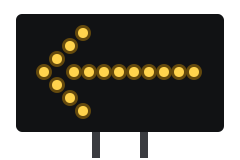
In a work zone you see this large flashing arrow panel. What does it tell you?
Show answer
A. Part of the road ahead is closed; move into the lane the arrow shows
Flashing arrow panels guide drivers into certain lanes and tell them that part of the road ahead is closed (Delaware Driver Manual, July 2026, p. 80).
Complete Study Guide: All 25 Questions with Answers
Every question in Quick Test, with the correct answer and an explanation for each.
-
Q1. A yellow warning sign alerts you to:
Correct answer: Hazards ahead
Why: Yellow signs warn of changing conditions or hazards.
-
Q2. When entering a roundabout you must:
Correct answer: Yield to traffic inside
Why: Traffic already in the circle has right-of-way.
-
Q3. Use low beams when driving in:
Correct answer: Fog or heavy rain
Why: Low beams reduce glare in poor weather.
-
Q4. You're behind a school bus that stops with its red lights flashing. What must you do?
Correct answer: Stop and wait until the red lights stop and the stop arm is pulled in
Why: Stop before reaching the bus, and do not go until the red lights stop flashing and the stop arm is pulled back. Only traffic on the opposite side of a highway with four or more lanes may keep going, slowly (Delaware Driver Manual, July 2026, p. 89).
-
Q5. A flashing red light means:
Correct answer: Stop then proceed
Why: A flashing red acts like a stop sign.
-
Q6. If your vehicle skids you should:
Correct answer: Steer toward intended path
Why: Steer gently where you want the vehicle to go.
-
Q7. When approaching a railroad crossing you should:
Correct answer: Look and listen
Why: Always check for trains before crossing.
-
Q8. When merging onto a roadway you must:
Correct answer: Match speed with traffic
Why: Match traffic speed to merge smoothly.
-
Q9. A broken white line separates lanes:
Correct answer: Moving in the same direction
Why: Broken white lines indicate same-direction traffic.
-
Q10. When following a motorcycle you should:
Correct answer: Increase following distance
Why: Motorcycles require extra space.
-
Q11. When driving at night adjust speed so you can stop within:
Correct answer: Distance you can see
Why: You must be able to stop within visible distance.
-
Q12. If another driver is tailgating you should:
Correct answer: Increase space ahead
Why: More space ahead gives you time to react safely.
-
Q13. Pedestrians have the right-of-way:
Correct answer: In crosswalks
Why: Pedestrians have the right-of-way in any crosswalk, marked or unmarked. Not all crosswalks are painted, so watch for people crossing at intersections (Delaware Driver Manual, July 2026, pp. 85, 95).
-
Q14. When driving through sun glare you should:
Correct answer: Slow down
Why: Sun glare reduces visibility—slowing helps.
-
Q15. A solid yellow line on your side means:
Correct answer: Do not pass
Why: A solid yellow line marks a no-passing zone.
-
Q16. A police car is stopped on the shoulder with its lights flashing. What must you do as you approach?
Correct answer: Move over a lane if you safely can; if not, slow down
Why: For a stopped emergency vehicle with flashing lights, change lanes away from it when possible. If you can't change lanes safely, slow to a safe speed until you're past (Delaware Driver Manual, July 2026, p. 82).
-
Q17. When turning right you should:
Correct answer: Stay close to right curb
Why: Right turns should be tight into the right lane.
-
Q18. On slick roads you should:
Correct answer: Increase following distance
Why: Extra distance allows more stopping time.
-
Q19. When approaching an uncontrolled intersection you should:
Correct answer: Be ready to yield
Why: Slow and be prepared to yield to other vehicles.
-
Q20. A flashing yellow light means:
Correct answer: Proceed with caution
Why: Flashing yellow requires careful driving.
-
Q21. To safely change lanes you must:
Correct answer: Check mirrors and blind spot
Why: Always check blind spots before moving over.
-
Q22. In a work zone you see this large flashing arrow panel. What does it tell you?
Correct answer: Part of the road ahead is closed; move into the lane the arrow shows
Why: Flashing arrow panels guide drivers into certain lanes and tell them that part of the road ahead is closed (Delaware Driver Manual, July 2026, p. 80).
-
Q23. On wet roads reduce speed to avoid:
Correct answer: Skidding
Why: Reduced traction increases risk of skidding.
-
Q24. When parking uphill with a curb:
Correct answer: Turn wheels away from curb
Why: Turning wheels away prevents rolling into traffic.
-
Q25. When approaching a blind pedestrian you must:
Correct answer: Yield completely
Why: Blind pedestrians always have right-of-way.