Arizona MVD Permit Practice Test 2: 50 Questions
Published · Updated
Practice Test 2 has 50 multiple-choice questions on Arizona driving rules, including steady yellow light, ice on bridges, reversible lanes and highway hypnosis. Each answer is explained as soon as you pick it, and every question is listed with its answer in the study guide below.
More Arizona Practice Tests
Practice by Topic
What Practice Test 2 Covers
The questions in this test ask about:
- Steady Yellow Light
- Flashing Yellow Signal
- Right Turn Signal Distance
- Ice on Bridges
- Railroad Advance Warning Sign
- Work zone sign shape
- Motorcycle Intersection Crashes
- Rural Freeway Speed Limit
- Dust Storm Stopping
- White Curb Parking
- Drying Wet Brakes
- Reversible Lanes
- Fire Hydrant Parking
- Highway Hypnosis
- Train Approaching Sign
Try 5 Questions from This Test
-
Traffic is heavy, and the light rail track-way beside you is empty. May you drive in it?
Show answer
A. No, never drive in the area where the train operates
Light rail runs in its own track-way, and you must never drive your car there (Arizona Driver License Manual, p. 49).
-
You are on a rural freeway and no speed limit is posted. What is the speed limit?
Show answer
C. 75 mph
When no limit is posted, the speed limit on rural freeways is 75 mph (Arizona Driver License Manual, p. 40).
-
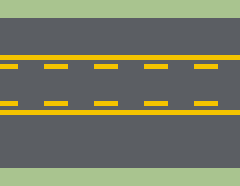
What is the center lane shown here used for?
Show answer
B. Only for vehicles turning left, from either direction
A two-way left turn lane is bordered by a solid outer and broken inner yellow line, and is only for vehicles turning left in either direction (Arizona Driver License Manual, p. 48).
-
A flashing yellow traffic signal at an intersection means you should:
Show answer
A. Slow down and proceed with caution
A flashing yellow warns you to slow and proceed carefully, watching for cross-traffic and pedestrians.
-
How close to a fire hydrant may you park?
Show answer
A. No closer than 15 feet
It is illegal to park within 15 feet of a fire hydrant (Arizona Driver License Manual, p. 31).
Complete Study Guide: All 50 Questions with Answers
Every question in Practice Test 2, with the correct answer and an explanation for each.
-
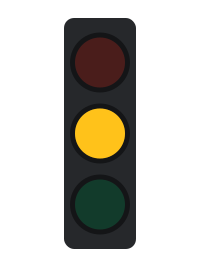
Q1. You are coming up to an intersection and the light turns steady yellow, like this, before you reach it. What should you do?
Correct answer: Come to a safe stop before entering the intersection
Why: A steady yellow light warns that the light is about to turn red. If you have not entered the intersection yet, you should come to a safe stop (Arizona Driver License Manual, p. 34).
-
Q2. A flashing yellow traffic signal at an intersection means you should:
Correct answer: Slow down and proceed with caution
Why: A flashing yellow warns you to slow and proceed carefully, watching for cross-traffic and pedestrians.
-
Q3. You plan to turn right at the next corner. What is the minimum distance before the turn at which you must start signaling?
Correct answer: 100 feet (about 4 seconds)
Why: Signal at least 100 feet (about 4 seconds) before you turn so other drivers have time to react.
-
Q4. You are about to back out of your driveway. When should you check behind your car?
Correct answer: Before you get in, since children and small objects are hard to see from the driver's seat
Why: Check behind your car before you get in. Children or small objects are hard to see from the driver's seat. (Arizona Driver License Manual, p. 30)
-
Q5. You pass a yellow, diamond-shaped sign on a country road. What does it tell you?
Correct answer: Be alert: it warns of a possible danger ahead
Why: Yellow, diamond-shaped signs warn of a possible danger ahead.
-
Q6. You are in a lane marked with a curved arrow and the word ONLY, like this. What must you do?
Correct answer: Turn in the direction of the arrow
Why: If your lane is marked with a curved arrow and the word ONLY, you must turn in the direction of the arrow.
-
Q7. You are driving on a cold winter day in Arizona. Where should you watch for ice first?
Correct answer: On bridges and in shady areas, because bridge surfaces freeze before other road surfaces
Why: Watch for ice on bridges and in shady areas. Bridge surfaces freeze before other road surfaces.
-
Q8. You park facing downhill next to a curb. Which way should you turn your front wheels?
Correct answer: Toward the curb, and set the parking brake
Why: When you park on a downhill grade, turn your wheels toward the curb and set your parking brake. (Arizona Driver License Manual, p. 30)
-
Q9. You are driving your 10-year-old brother to school. Where should he ride?
Correct answer: In the back seat
Why: Air bags are unsafe for young children, so children age 12 and under should never ride in the front seat (Arizona Driver License Manual, p. 20).
-
Q10. What does this round yellow sign mean?

Correct answer: You are approaching a railroad crossing
Why: A round (circle-shaped) sign warns that you are coming up to a railroad crossing (Arizona Driver License Manual, p. 42).
-
Q11. How many hands should you keep on the steering wheel while you drive?
Correct answer: Both hands
Why: Keep both hands on the steering wheel so you have full control of the vehicle (Arizona Driver License Manual, p. 24).
-
Q12. Most signs used in highway and street work zones are what shape?
Correct answer: Diamond
Why: Construction and maintenance signs warn of danger in or near work areas, and most of them are diamond-shaped. The octagon is used only for stop signs (Arizona Driver License Manual, p. 44).
-
Q13. At intersections, what usually causes a crash between a car and a motorcycle?
Correct answer: A driver turning into the motorcycle's path
Why: Most car and motorcycle crashes at intersections happen when a driver turns into the motorcycle's path, often because the driver did not see it (Arizona Driver License Manual, p. 51).
-
Q14. It is rainy and windy. Why should you take extra care around motorcycles?
Correct answer: Motorcycles are less stable in rain and wind
Why: Bad weather affects motorcyclists, who are less stable in rain and wind, so watch for them closely (Arizona Driver License Manual, p. 51).
-
Q15. You have the right-of-way at an intersection, but another driver pulls out in front of you anyway. What should you do?
Correct answer: Yield to avoid a crash, because no one may take the right-of-way if it could cause a crash
Why: The law only says who must yield; it does not give anyone the right-of-way. No one may take the right-of-way if that could cause a crash (Arizona Driver License Manual, p. 36).
-
Q16. You speed up from city streets to a fast highway. What should happen to the distance between you and the car ahead?
Correct answer: It should be greater
Why: At faster speeds you travel farther while reacting to a problem, so the distance to the car ahead should be greater (Arizona Driver License Manual, p. 25).
-
Q17. You have just passed a motorcycle. Why shouldn't you move back into its lane too soon?
Correct answer: It can force the rider to swerve into traffic or off the road
Why: Give the motorcycle plenty of room after you pass; cutting back in too soon can force the rider to swerve (Arizona Driver License Manual, p. 51).
-
Q18. There is no sign about U-turns at a city intersection. When may you make a U-turn there?
Correct answer: When it can be done safely without getting in the way of other traffic
Why: U-turns are allowed if you can make them safely, they don't interfere with other traffic, and no sign prohibits them. You must yield to approaching traffic (Arizona Driver License Manual, p. 37).
-
Q19. You are following a large truck. Why should you stay well back?
Correct answer: If you follow too closely, you won't be able to react quickly enough to changing traffic
Why: Trucks are almost as wide as some lanes, so following closely leaves you unable to see and react to traffic ahead (Arizona Driver License Manual, p. 52).
-
Q20. You are driving near a stopped school bus. Why should you take extra care?
Correct answer: A child may dart out from the front or the rear of the bus
Why: Use extreme care near any stopped school bus. A child may dart out from in front of or behind the bus (Arizona Driver License Manual, p. 39).
-
Q21. Which of these directly affects how far your car travels before it stops?
Correct answer: Your speed, the road surface, and your tires and brakes
Why: Braking distance depends on your speed, your perception and reaction time, the pavement, your tires, the vehicle's weight and your brakes (Arizona Driver License Manual, p. 53).
-
Q22. There are double solid yellow lines like these down the center of the road. When may you cross them?

Correct answer: Only when you are turning left
Why: Double solid yellow lines mean no passing in either direction. You may cross them only to turn left (Arizona Driver License Manual, p. 45).
-
Q23. You are on a rural freeway and no speed limit is posted. What is the speed limit?
Correct answer: 75 mph
Why: When no limit is posted, the speed limit on rural freeways is 75 mph (Arizona Driver License Manual, p. 40).
-
Q24. You see a bicycle symbol like this painted in your lane. What does it mean?
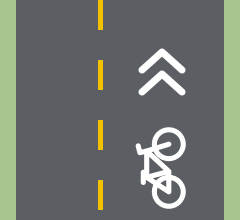
Correct answer: Bicyclists may be present, so use caution
Why: A bicycle painted on the road means bicyclists may be there, so drive with caution (Arizona Driver License Manual, p. 45).
-
Q25. You are caught in a severe dust storm and need to stop. Where should you stop?
Correct answer: Completely off the highway, as far to the right as possible
Why: In a severe dust storm, drive completely off the highway and stop as far right as you can, never in a travel lane or the emergency lane (Arizona Driver License Manual, p. 55).
-
Q26. You pull up to a curb that is painted white. What may you do there?
Correct answer: Stop only long enough to pick up or drop off passengers
Why: A white curb means you may stop only long enough to pick up or drop off passengers (Arizona Driver License Manual, p. 46).
-
Q27. You see a dust storm ahead on the highway. What should you do right away?
Correct answer: Check the traffic around you and begin slowing down
Why: When you meet a dust storm, check traffic around you and start slowing down at once, then pull off as soon as you can (Arizona Driver License Manual, p. 55).
-
Q28. You are on a highway clearly marked with two lanes going your direction, and a slow car is in the left lane. May you pass it on the right?
Correct answer: Yes, if it is safe
Why: Passing on the right is allowed when it is safe and the highway is marked for two or more lanes going your way. Never drive off the pavement to pass (Arizona Driver License Manual, p. 27).
-
Q29. You are behind a slow car, and a railroad crossing is about 80 feet ahead. May you pass?
Correct answer: No, you may not pass within 100 feet of a railroad crossing
Why: You must not pass when you are within 100 feet of a railroad crossing (Arizona Driver License Manual, p. 28).
-
Q30. When may you cross the solid white line that marks the right edge of the road?
Correct answer: Only in an emergency or to avoid a road hazard
Why: The solid white line on the right edge of the road should be crossed only in an emergency or to avoid a hazard (Arizona Driver License Manual, p. 46).
-
Q31. You and a large truck reach a roundabout entrance at the same time. Who should go first?
Correct answer: The truck; you must yield to it
Why: Drivers approaching a roundabout must yield to vehicles already inside and to large vehicles entering at the same time (Arizona Driver License Manual, p. 28).
-
Q32. A double solid white line like this separates your lane from the lane next to you. May you cross it?

Correct answer: No, crossing a double solid white line is prohibited
Why: A double solid white line separates two lanes going the same way, and you may not cross it (Arizona Driver License Manual, p. 46).
-
Q33. You just drove through deep water and your brakes feel wet. How can you dry them?
Correct answer: Accelerate slowly while gently holding down the brake pedal
Why: Wet brakes may grab or pull to one side, so test them and dry them by driving slowly while gently pressing the brake (Arizona Driver License Manual, p. 56).
-
Q34. You are driving on a divided highway. What does a single solid yellow line on your left mark?
Correct answer: The left edge of the pavement
Why: On divided highways and one-way streets, a single yellow line may mark the left edge of the pavement (Arizona Driver License Manual, p. 46).
-
Q35. You are driving in fog with your low beams on. What can help guide you?
Correct answer: The road edge markings
Why: In fog, use low beams only and follow the road edge markings, and slow down (Arizona Driver License Manual, p. 56).
-
Q36. Some lanes carry traffic one way at certain times and the other way at other times. How are these reversible lanes usually marked?
Correct answer: With double-dashed yellow lines
Why: Reversible lanes change direction at different times and are usually marked by double-dashed yellow lines (Arizona Driver License Manual, p. 46).
-
Q37. How close to a fire hydrant may you park?
Correct answer: No closer than 15 feet
Why: It is illegal to park within 15 feet of a fire hydrant (Arizona Driver License Manual, p. 31).
-
Q38. Before you start driving in a reversible lane, what should you do?
Correct answer: Check the signs beside the road or overhead to see which lanes you can use
Why: Before using a reversible lane, check which lanes you can use at that time. Signs may be posted beside the road or overhead (Arizona Driver License Manual, pp. 46-47).
-
Q39. You want to park near a railroad crossing. What is the closest you may park to it?
Correct answer: 50 feet
Why: It is illegal to park within 50 feet of a railroad crossing (Arizona Driver License Manual, p. 31).
-
Q40. As you make a turn, what should you check for?
Correct answer: Pedestrians, mopeds and bicycles
Why: Signal, slow down and turn smoothly, and check for pedestrians, mopeds and bicycles as you turn (Arizona Driver License Manual, p. 47).
-
Q41. You are merging onto a freeway from the on-ramp. Who has the right-of-way?
Correct answer: Traffic already on the freeway
Why: Traffic entering a freeway must yield to traffic already on it. Drivers entering are responsible for merging safely (Arizona Driver License Manual, p. 31).
-
Q42. You are on a long highway drive and starting to feel in a trance, sometimes called highway hypnosis. What helps keep you alert?
Correct answer: Fresh air, the radio, and a stop every hour to walk around
Why: Use the radio and fresh air, and stop every hour to walk and exercise; if you feel tired, pull over and rest (Arizona Driver License Manual, p. 58).
-
Q43. You are on a two-way road and about to turn left onto another two-way road. Which lane should you be in as you approach?
Correct answer: The lane just to the right of the center line
Why: On a two-way road, approach a left turn in the lane just to the right of the center line (Arizona Driver License Manual, p. 47).
-
Q44. Your car has a problem on the freeway and you need help. Where should you pull over?
Correct answer: Onto the right shoulder, as far over as possible
Why: Pull onto the right shoulder as far as you can, and avoid stopping on or near freeway ramps (Arizona Driver License Manual, p. 32).
-
Q45. What does this yellow sign warn you about?

Correct answer: A "Y" intersection ahead, where the road splits in two
Why: This yellow diamond warning sign marks a "Y" intersection, where the road splits into two directions ahead (Arizona Driver License Manual, p. 41).
-
Q46. What is the center lane shown here used for?
Correct answer: Only for vehicles turning left, from either direction
Why: A two-way left turn lane is bordered by a solid outer and broken inner yellow line, and is only for vehicles turning left in either direction (Arizona Driver License Manual, p. 48).
-
Q47. You are about to use a two-way left turn lane to turn left off the street. How should you enter it?
Correct answer: Signal before entering, then move completely into the lane
Why: Signal before you enter a two-way left turn lane and move all the way into it (Arizona Driver License Manual, p. 48).
-
Q48. Traffic is heavy, and the light rail track-way beside you is empty. May you drive in it?
Correct answer: No, never drive in the area where the train operates
Why: Light rail runs in its own track-way, and you must never drive your car there (Arizona Driver License Manual, p. 49).
-
Q49. At a light rail intersection, the electronic Train Approaching sign is flashing. What does it mean?
Correct answer: A train is coming toward the intersection
Why: Train Approaching signs are posted at all METRO light rail intersections and flash when a train is coming (Arizona Driver License Manual, p. 49).
-
Q50. Your headlights suddenly go out while you are driving at night. What should you try first?
Correct answer: The high beam/low beam switch
Why: If your headlights fail, try the high beam/low beam switch first, since it may restore normal function (Arizona Driver License Manual, p. 69).