Arizona MVD Permit Practice Test 4: 50 Questions
Published · Updated
Practice Test 4 has 50 multiple-choice questions on Arizona driving rules, including seat belt age rule, parallel parking, passing on a hill and waiting out a dust storm. Each answer is explained as soon as you pick it, and every question is listed with its answer in the study guide below.
More Arizona Practice Tests
Practice by Topic
What Practice Test 4 Covers
The questions in this test ask about:
- Seat Belt Age Rule
- Blind Spots
- Blocked View at Intersection
- Parallel Parking
- No Parking at Driveways
- Speeding to Beat a Yellow
- Stopping at School Crossings
- Funeral Processions
- Passing on a Hill
- Railroad Barricades
- Truck Wide Right Turns
- Turn and Straight Arrows
- Left Turn Into One-Way Road
- Waiting Out a Dust Storm
Try 5 Questions from This Test
-
You are driving through a school crossing and a child is in the crosswalk. When does the law require you to come to a complete stop?
Show answer
B. Whenever any person is in the crosswalk
The law requires vehicles to come to a complete stop at any school crossing when the crosswalk is occupied by any person.
-
You are turning left from a two-way road. Where in the intersection should you make the turn?
Show answer
B. Just to the left of the center point of the intersection
When turning left from a two-way road, turn just to the left of the center point of the intersection.
-
You will be driving down a one-way street for several blocks. Which lane is best?
Show answer
A. The center lane
On a one-way street for several blocks, it is best to stay in the center lane, because turning vehicles use the left and right lanes.
-
A pedestrian is crossing in a crosswalk ahead of you and the road is icy. What should you do?
Show answer
A. Slow down early and stop to let the pedestrian cross
On ice or packed snow, slow down before stopping (Arizona Driver License Manual, p. 57). You must yield the right-of-way to pedestrians crossing the street in any marked or unmarked crosswalk. (Arizona Driver License Manual, p. 36)
-
You want to change lanes across broken white lines like the one shown. May you cross them?
Show answer
C. Yes, with caution, after you signal
Broken white lines separate lanes of traffic going in the same direction and may be crossed with caution. Remember to signal that you are changing lanes.
Complete Study Guide: All 50 Questions with Answers
Every question in Practice Test 4, with the correct answer and an explanation for each.
-
Q1. You are giving your 15-year-old cousin a ride. Arizona law makes you, the driver, responsible for making passengers buckle up if they are under what age?
Correct answer: 16
Why: The operator of a motor vehicle must require all passengers under the age of 16 to buckle up.
-
Q2. A bicyclist is riding on the road ahead of you. Which traffic laws must the rider follow?
Correct answer: The same traffic laws as drivers of vehicles
Why: Bicyclists must obey the same traffic laws as drivers and have the right-of-way under the same conditions (Arizona Driver License Manual, p. 50).
-
Q3. You are driving down a busy city street and want to avoid last-second lane changes and braking. How far ahead should you be looking?
Correct answer: About one city block
Why: To avoid the need for last-minute decision making, look ahead for a distance of about one city block.
-
Q4. You notice you have been cruising in the blind spot of the truck beside you. What should you do?
Correct answer: Speed up or drop back rather than staying there
Why: Speed up or drop back, but never stay for an extended time in another driver's blind spot.
-
Q5. You are driving behind a school bus on a divided highway when it stops with its lights flashing and its stop-sign arm out. What must you do?
Correct answer: Stop before reaching the bus and stay stopped until it moves or the lights and arm are off
Why: When a school bus is picking up or dropping off passengers, you must stop before reaching the bus no matter which direction you are traveling. Only traffic going the opposite way on a divided roadway may go ahead. (Arizona Driver License Manual, p. 39)
-
Q6. The driver ahead has slowed and is signaling a left turn, and the paved lane to the right is clear. May you pass on the right?
Correct answer: Yes, if it is safe, because the driver ahead is turning left
Why: Passing on the right is permitted only when it is safe and certain conditions are met, such as the driver of the other vehicle turning left. Never pass to the left of a driver who has signaled a left turn.
-
Q7. You are behind a slow truck and a bridge is coming up. Passing within 100 feet of a bridge, tunnel or underpass is not allowed when:
Correct answer: Your view is blocked
Why: You must not pass within 100 feet of a bridge, tunnel or underpass where your view is blocked.
-
Q8. You stop at an intersection, but parked cars and bushes block your view of cross traffic. What should you do?
Correct answer: Slowly inch forward until you have a clear view, then go when it is clear
Why: When parked vehicles, bushes, trees or buildings block your view at an intersection, slowly inch forward until you have a clear view, then proceed when the way is clear.
-
Q9. Near railroad crossings, why should you watch for buses and gasoline tankers?
Correct answer: They must stop at railroad crossings
Why: Buses and gasoline tankers must stop at railroad crossings, so be ready for them to stop ahead of you (Arizona Driver License Manual, p. 43).
-
Q10. You pull up beside the car in front of an open parallel parking space. About how much space should you leave between your car and that car?
Correct answer: About two feet
Why: When you stop alongside the forward car, leave approximately two feet between you and the forward car.
-
Q11. The only open spot on the street is in front of a neighbor's driveway, and you'll only be a few minutes. May you park there?
Correct answer: No, it is illegal to park in front of a public or private driveway
Why: It is illegal to park in front of a private or public driveway, even for a short time (Arizona Driver License Manual, p. 31).
-
Q12. Traffic is light and you want to stop on a bridge to take a photo. May you park your car on a bridge or inside a tunnel?
Correct answer: No, parking on a bridge or within a tunnel is illegal
Why: The manual lists parking on a bridge or within a tunnel as illegal.
-
Q13. It is weekday rush hour, and the far-left freeway lane has white diamonds painted on the pavement. What kind of lane is it?
Correct answer: An HOV (carpool) lane
Why: HOV lanes are indicated by white diamonds in the roadway.
-
Q14. You are about to change lanes on an empty-looking road and see no other cars nearby. Should you still signal?
Correct answer: Signal anyway, because the vehicle you don't see is the most dangerous one
Why: Make a habit of using your turn signals even when you don't see other vehicles or motorcycles. The vehicle or motorcycle you do not see is the most dangerous one.
-
Q15. You are already in the intersection when the light turns steady yellow. What should you do?
Correct answer: Keep moving and clear the intersection safely
Why: A steady yellow light warns that the light is about to turn red. If you are already in the intersection, continue moving and clear it safely; if you have not entered it, come to a safe stop.
-
Q16. The light ahead turns yellow and you think you can make it if you speed up. Is it legal to speed up to beat the light?
Correct answer: No, speeding up to beat the light is illegal
Why: Speeding up to “beat the light” is illegal and could cause a crash.
-
Q17. You are approaching the intersection to turn left and the arrow turns steady yellow before you enter. What must you do?
Correct answer: Stop if you can do so safely
Why: A yellow arrow warns that the light is about to change to red. If you have not entered the intersection, you must stop and wait for a green arrow.
-
Q18. You are driving through a school crossing and a child is in the crosswalk. When does the law require you to come to a complete stop?
Correct answer: Whenever any person is in the crosswalk
Why: The law requires vehicles to come to a complete stop at any school crossing when the crosswalk is occupied by any person.
-
Q19. A pedestrian is crossing in a crosswalk ahead of you and the road is icy. What should you do?
Correct answer: Slow down early and stop to let the pedestrian cross
Why: On ice or packed snow, slow down before stopping (Arizona Driver License Manual, p. 57). You must yield the right-of-way to pedestrians crossing the street in any marked or unmarked crosswalk. (Arizona Driver License Manual, p. 36)
-
Q20. You come to a pedestrian crosswalk signal, like this one, and all of its lights are blank. What should you do?
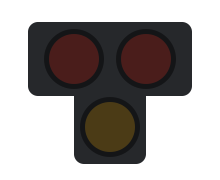
Correct answer: Proceed with caution if the crosswalk is clear
Why: When all the lights on a pedestrian crosswalk signal are blank, proceed with caution if the crosswalk is clear.
-
Q21. You are pulling out of a driveway onto a street with a sidewalk. Where must you stop?
Correct answer: Before you reach the sidewalk
Why: When entering the roadway from an alley or driveway, stop before reaching the sidewalk, and yield the right-of-way to pedestrians and approaching vehicles.
-
Q22. You come to a T intersection with no signs or signals on a neighborhood street. Who has the right-of-way?
Correct answer: The driver on the road that goes straight through
Why: At a T intersection, the driver on the street that ends must yield the right-of-way to vehicles on the cross street. (Arizona Driver License Manual, p. 35)
-
Q23. Your light is green, but a funeral procession led by an escort vehicle flashing a red light is moving through the intersection. What should you do?
Correct answer: Yield to the vehicles in the procession
Why: Drivers must yield the right-of-way to any vehicle in a funeral procession that is led by a funeral escort vehicle flashing a red or a blue light.
-
Q24. You're on a city freeway where no speed limit is posted. What is the speed limit?
Correct answer: 55 mph
Why: When no limit is posted, the speed limit on open highways and city freeways is 55 mph (Arizona Driver License Manual, p. 40).
-
Q25. You pass a white sign with black letters reading SPEED LIMIT 50, like this one. What does it show?
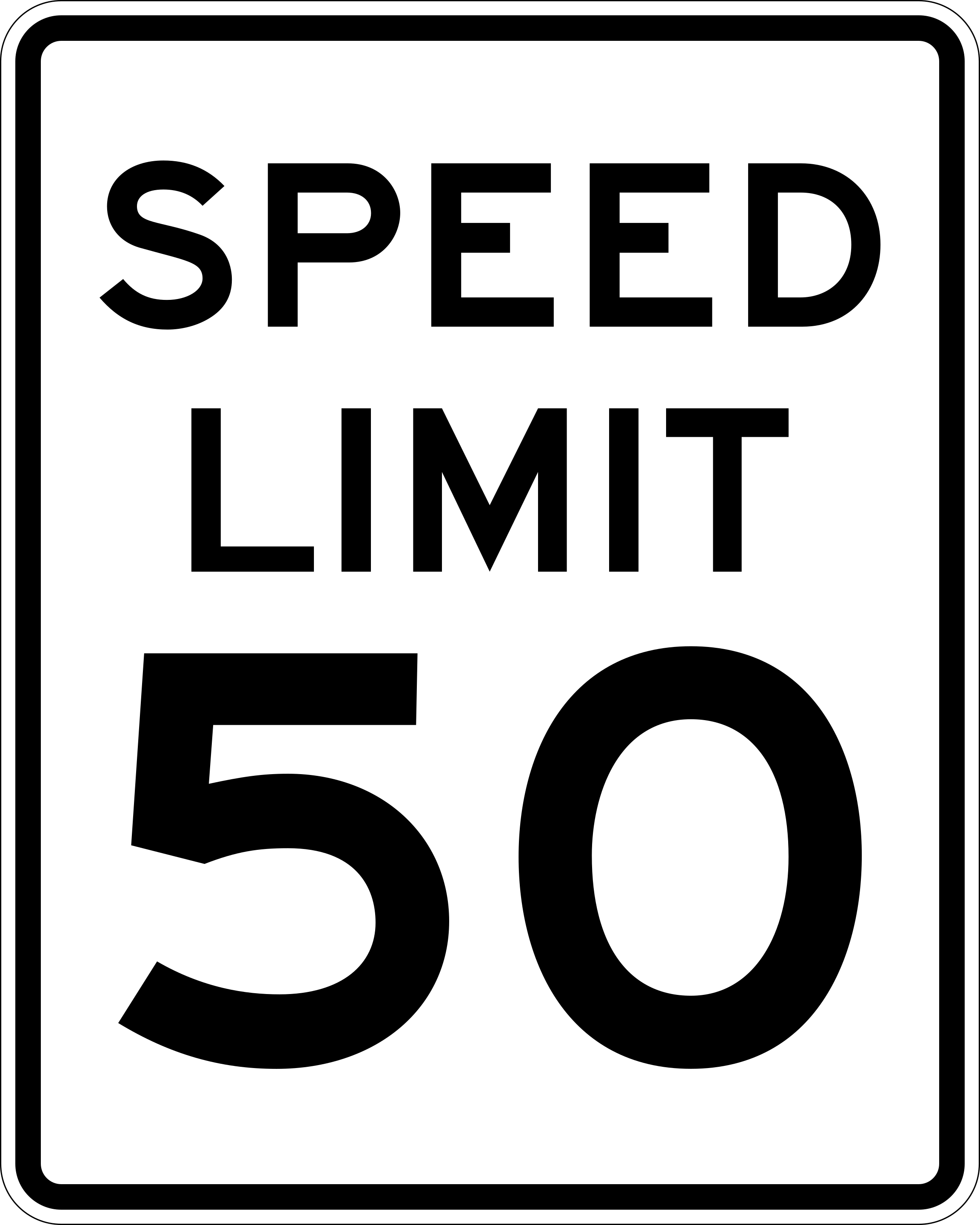
Correct answer: The maximum speed you can legally go
Why: White speed limit signs with black letters are regulatory signs. They show the maximum speed you can legally go.
-
Q26. You are stuck behind a slow car as you approach the top of a hill and cannot see the other side. May you pass?
Correct answer: No, not when you cannot see ahead to be sure passing is safe
Why: You must not pass when approaching a curve or the top of a hill where you cannot see ahead to be sure of safe passing.
-
Q27. You see a pennant-shaped sign on the left side of a two-lane road. What does it mark?
Correct answer: The beginning of a no-passing zone
Why: A pennant-shaped sign marks the beginning of a no-passing zone.
-
Q28. If visibility suddenly drops due to blowing snow (‘whiteout’), you should:
Correct answer: Slow down, turn on low-beam headlights, and be ready to pull off safely
Why: Use low beams, slow down, and pull off safely if needed.
-
Q29. You reach a railroad crossing and the barricade is lowered, but you see no train. What should you do?
Correct answer: Stay stopped and do not drive around or under it
Why: Never drive around or under a lowered crossing barricade. Do not cross until all signals have stopped and the barricade is up all the way (Arizona Driver License Manual, p. 42).
-
Q30. You drive past a school at 7 p.m. and the portable school crossing signs are not out. What speed limit applies?
Correct answer: The normal speed limit for the area
Why: With the portable signs in place, the maximum speed from the first sign to past the school crossing sign is 15 mph. When the portable signs are not in place, the normal speed limit for the area applies.
-
Q31. You are behind a slow car in a school crossing zone. May you pass?
Correct answer: No, passing in a school crossing zone is prohibited
Why: Passing another vehicle in a school crossing zone is prohibited.
-
Q32. The car in the lane next to you has stopped for a pedestrian, but your lane is open and your light is green. What should you do?
Correct answer: Do not pass the stopped car
Why: You may not pass another vehicle that is stopped for a pedestrian, even if you have a clear lane or a green traffic signal.
-
Q33. A truck ahead is signaling a right turn and has swung wide, leaving an open space on its right. What should you do?
Correct answer: Don't pass on the right; trucks make wide right turns
Why: Trucks make wide right turns and sometimes leave an open space to the right just before the turn. Do not pass a truck on the right if there is any chance it might turn right.
-
Q34. You want to change lanes across broken white lines like the one shown. May you cross them?

Correct answer: Yes, with caution, after you signal
Why: Broken white lines separate lanes of traffic going in the same direction and may be crossed with caution. Remember to signal that you are changing lanes.
-
Q35. Your lane is marked with both a curved arrow and a straight arrow, like this. What may you do?
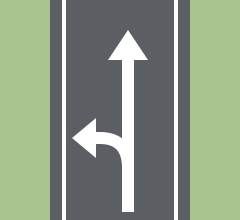
Correct answer: Turn in the direction of the curved arrow or go straight
Why: If your lane is marked with both a curved and a straight arrow, you may turn in the direction of the arrow or go straight.
-
Q36. You will be driving down a one-way street for several blocks. Which lane is best?
Correct answer: The center lane
Why: On a one-way street for several blocks, it is best to stay in the center lane, because turning vehicles use the left and right lanes.
-
Q37. You are preparing to turn right at the next corner. Where should your vehicle be as you approach?
Correct answer: Close to the right curb or edge of the road
Why: As you prepare to turn right, stay close to the right curb or edge of the road. Do not swing wide before or while turning.
-
Q38. You are turning left from a two-way road. Where in the intersection should you make the turn?
Correct answer: Just to the left of the center point of the intersection
Why: When turning left from a two-way road, turn just to the left of the center point of the intersection.
-
Q39. The intersection ahead has a lane signed and marked for left turns. Where should you turn left from?
Correct answer: Only from that left-turn lane
Why: If a special lane for left turns has been signed or marked, use that lane. Do not turn left from any other lane.
-
Q40. You are turning left from a two-way road onto a one-way road. Which lane should you turn into?
Correct answer: The extreme left lane of the road you are entering
Why: Approach in the lane just to the right of the center line, and as you enter the intersection, turn into the extreme left lane of the one-way road.
-
Q41. Traffic is slow and there is an open two-way left-turn lane beside you, like this one. May you use it to pass?
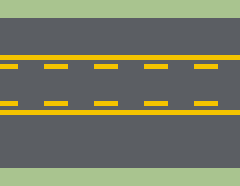
Correct answer: No, never use it for passing or through travel
Why: Do not use the two-way left-turn lane for passing, for through traffic, or to speed up to merge with through traffic.
-
Q42. You are following another car at night with your high beams on. Within what distance of that car should you switch to low beams?
Correct answer: 200 feet
Why: When following another car, use low beams whenever you are within 200 feet. (Arizona Driver License Manual, p. 57)
-
Q43. You see a motorcycle approaching as you wait to turn left. Because of its smaller size, how may it appear to you?
Correct answer: Farther away and slower than it really is
Why: A motorcycle's smaller size may make it hard to spot in traffic, and it may appear to be farther away and traveling slower than it actually is.
-
Q44. You want to pull out from a side street, and an approaching motorcycle has had its right turn signal on for several blocks. What should you do?
Correct answer: Wait until you're sure what the rider is doing, because the signal may have been left on
Why: Motorcycle turn signals do not automatically shut off, and riders may forget to cancel them. Make sure you know what the rider is doing before you move into the motorcycle's path.
-
Q45. You want to move in front of a big truck just before your exit. Why shouldn't you cut in front of a truck?
Correct answer: It takes trucks twice as long to stop
Why: It takes trucks twice as long to stop. If you cut in front of a truck and then brake suddenly, you cut its available stopping distance in half.
-
Q46. A crossing guard is helping children cross the road at a school crossing. What should you do?
Correct answer: Follow the crossing guard's instructions
Why: Crossing guards often help children cross, and you must follow their instructions (Arizona Driver License Manual, p. 42).
-
Q47. You come up quickly behind a vehicle showing this orange triangle on its back. What should you expect?

Correct answer: It cannot go faster than 25 mph, so slow down
Why: The slow-moving vehicle symbol on the back of a vehicle is a warning to slow down. The vehicle with the sign cannot travel faster than 25 mph.
-
Q48. You are driving at night and a bicyclist is coming toward you. What should you do with your headlights?
Correct answer: Dim them
Why: At night, dim your headlights for bicyclists, just as you would for other traffic (Arizona Driver License Manual, p. 50).
-
Q49. You see a dust storm moving across the road ahead. When should you pull off the roadway?
Correct answer: As soon as possible, before poor visibility makes it hard
Why: If you encounter a dust storm, check traffic around you and begin slowing down. Don't wait until poor visibility makes it hard to pull off safely; do it as soon as possible.
-
Q50. You have stopped safely off the highway in a severe dust storm. What should you do now?
Correct answer: Stay inside with your seat belt buckled until it passes
Why: Stay in the vehicle with your seat belts buckled, and wait until the dust storm has passed.