Florida DMV Permit Practice Mini Test 3: 12 Questions
Published · Updated
Mini Test 3 has 12 multiple-choice questions on Florida driving rules, including child restraint law, school bus stop ahead sign, school bus red lights and bicycle passing minimum. Each answer is explained as soon as you pick it, and every question is listed with its answer in the study guide below.
More Florida Practice Tests
Practice by Topic
What Mini Test 3 Covers
The questions in this test ask about:
- Left on Red One-Way to One-Way
- School Bus Red Lights
- Headlights in Florida
- Red Reflectors on Lane Lines
- Child Restraint Law
- School Bus Stop Ahead Sign
- Steer It Clear It
- Bicycle Passing Minimum
- Roundabout Entry
- Right Turn on Red
- Move Over for Disabled Cars
Try 5 Questions from This Test
-
Child restraint requirement in Florida:
Show answer
C. Children age 5 and under must ride in an approved child restraint
Children under 4 must ride in a safety seat, and children ages 4 and 5 must ride in a safety seat or a booster seat (Florida Driver License Handbook, p. 28).
-
You see a yellow "School Bus Stop Ahead" sign before a curve. What should you do?
Show answer
C. Be prepared to stop for a school bus ahead
This sign warns of an upcoming school bus stop that may be hidden by a curve or hill. Be prepared to stop (Florida Driver License Handbook, p. 57).
-
When passing a bicyclist in Florida, you must provide at least:
Show answer
C. 3 feet of clearance
Florida law requires a minimum of 3 feet of clearance, and you should use caution and a slow speed when passing (Florida Driver License Handbook, p. 81).
-
Roundabout rule in Florida:
Show answer
B. Yield to traffic already in the circle; enter when safe and travel counterclockwise
Yield to circulating traffic and pedestrians; roundabouts flow counterclockwise.
-
On a multi-lane highway, a disabled car is stopped on the shoulder with its hazard lights flashing. What must you do?
Show answer
A. Leave the lane closest to it, or slow to 20 mph below the limit if you can't move over
Florida's Move Over Law also covers disabled vehicles stopped with hazard lights, flares or signs, or with people visibly present. On a multi-lane road, leave the lane closest to the stopped vehicle. If you can't move over safely, slow to 20 mph below the posted limit (Florida Driver License Handbook, p. 65).
Complete Study Guide: All 12 Questions with Answers
Every question in Mini Test 3, with the correct answer and an explanation for each.
-
Q1. You're in a left-turn lane. What does this steady yellow arrow mean?
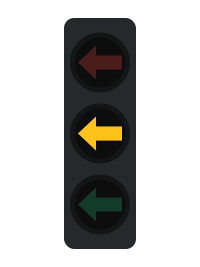
Correct answer: The green arrow is ending; stop if you can do so safely
Why: A steady yellow arrow means the green arrow is ending or the light is about to turn red. Stop if you can do so safely (Florida Driver License Handbook, p. 52).
-
Q2. Left turn on red in Florida is allowed:
Correct answer: From a one-way street onto another one-way street after a complete stop (unless prohibited by sign)
Why: Florida permits left-on-red only from one-way to one-way after stopping and when permitted.
-
Q3. School bus with flashing red lights: Oncoming traffic does NOT have to stop when:
Correct answer: The roadway is divided by a physical median or an unpaved space of at least 5 feet
Why: On divided highways (raised median, barrier, or ≥5 ft unpaved space), oncoming drivers do not stop.
-
Q4. Headlight use in Florida:
Correct answer: Required from sunset to sunrise and during rain, smoke, or fog that reduces visibility
Why: Use headlights at night and any time weather reduces visibility; use low beams in rain/fog.
-
Q5. At night you see red reflectors facing you on the lane lines. What does this mean?
Correct answer: You are on the wrong side of the road and must get into the proper lane right away
Why: Red reflectors facing you on the lane lines mean you are on the wrong side of the road. Turn around or get into the proper lane immediately (Florida Driver License Handbook, p. 69).
-
Q6. Child restraint requirement in Florida:
Correct answer: Children age 5 and under must ride in an approved child restraint
Why: Children under 4 must ride in a safety seat, and children ages 4 and 5 must ride in a safety seat or a booster seat (Florida Driver License Handbook, p. 28).
-
Q7. You see a yellow "School Bus Stop Ahead" sign before a curve. What should you do?
Correct answer: Be prepared to stop for a school bus ahead
Why: This sign warns of an upcoming school bus stop that may be hidden by a curve or hill. Be prepared to stop (Florida Driver License Handbook, p. 57).
-
Q8. After a minor crash with no injuries and operable vehicles, Florida's guidance is to:
Correct answer: Move vehicles out of travel lanes to a safe area and then exchange information
Why: If the crash is minor and your vehicle is blocking traffic, you must move it or have it moved, then exchange driver, vehicle and insurance information (Florida Driver License Handbook, p. 77).
-
Q9. When passing a bicyclist in Florida, you must provide at least:
Correct answer: 3 feet of clearance
Why: Florida law requires a minimum of 3 feet of clearance, and you should use caution and a slow speed when passing (Florida Driver License Handbook, p. 81).
-
Q10. Roundabout rule in Florida:
Correct answer: Yield to traffic already in the circle; enter when safe and travel counterclockwise
Why: Yield to circulating traffic and pedestrians; roundabouts flow counterclockwise.
-
Q11. Right turn on red in Florida:
Correct answer: Allowed after a complete stop unless a sign prohibits it
Why: Stop fully, yield to pedestrians and traffic, then turn if not prohibited.
-
Q12. On a multi-lane highway, a disabled car is stopped on the shoulder with its hazard lights flashing. What must you do?
Correct answer: Leave the lane closest to it, or slow to 20 mph below the limit if you can't move over
Why: Florida's Move Over Law also covers disabled vehicles stopped with hazard lights, flares or signs, or with people visibly present. On a multi-lane road, leave the lane closest to the stopped vehicle. If you can't move over safely, slow to 20 mph below the posted limit (Florida Driver License Handbook, p. 65).