Colorado DMV Permit Practice Test 2: 50 Questions
Published · Updated
Practice Test 2 has 50 multiple-choice questions on Colorado driving rules, including flashing yellow signal, THC blood limit, metered freeway ramps and hitting a parked car. Each answer is explained as soon as you pick it, and every question is listed with its answer in the study guide below.
More Colorado Practice Tests
Practice by Topic
What Practice Test 2 Covers
The questions in this test ask about:
- Green Arrow Signal
- Flashing Yellow Signal
- THC Blood Limit
- Icy Crosswalk Stops
- Residential Speed Limit
- Checking the Mirror
- Stop Sign Parking Distance
- Railroad Crossbuck Sign
- Headlight Failure
- Metered Freeway Ramps
- Bike Lane Right-of-Way
- Melting Snow and Ice
- School Bus Stopping Distance
Try 5 Questions from This Test
-
The best way to merge onto a freeway is to:
Show answer
B. Match the speed of traffic and merge when safe
Use the acceleration lane to reach traffic speed and merge smoothly when a safe gap appears.
-
You park headed uphill on a road with no curb. Which way should you turn your front wheels?
Show answer
C. To the right
With no curb, turn your front wheels to the right so that if the car rolls, it rolls off the road instead of into traffic (Colorado Driver Handbook, p. 14).
-
A flashing yellow traffic signal at an intersection means you should:
Show answer
A. Slow down and proceed with caution
A flashing yellow warns you to slow and proceed carefully, watching for cross-traffic and pedestrians.
-
May you drive with only your parking lights on?
Show answer
A. No, do not drive with only your parking lights on
Do not drive with only your parking lights on. Use your headlights from sunset to sunrise or whenever you can't see 1,000 feet ahead (Colorado Driver Handbook, p. 16).
-
What colors are work zone signs?
Show answer
B. Orange background with black letters or symbols
Work zone signs have an orange background with black letters or symbols (Colorado Driver Handbook, DR 2337, January 2025, p. 8).
Complete Study Guide: All 50 Questions with Answers
Every question in Practice Test 2, with the correct answer and an explanation for each.
-
Q1. What does a steady green arrow, like this one, mean?
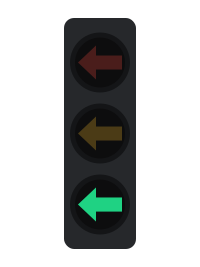
Correct answer: You may turn in the direction the arrow points
Why: A lighted green arrow means you may turn in the direction it shows (Colorado Driver Handbook, p. 7).
-
Q2. A flashing yellow traffic signal at an intersection means you should:
Correct answer: Slow down and proceed with caution
Why: A flashing yellow warns you to slow and proceed carefully, watching for cross-traffic and pedestrians.
-
Q3. How often should you check traffic behind you in your rearview mirror?
Correct answer: Every 5 to 8 seconds
Why: Check traffic behind you in your rearview mirror every 5 to 8 seconds, and more often when traffic is heavy (Colorado Driver Handbook, p. 18).
-
Q4. The maximum speed shown on a speed limit sign like this one is meant for:
Correct answer: Ideal conditions; you must slow down when conditions require it
Why: Maximum speed limits are for ideal conditions, and you must reduce your speed when conditions require it (Colorado Driver Handbook, DR 2337, January 2025, p. 7).
-
Q5. What colors are work zone signs?
Correct answer: Orange background with black letters or symbols
Why: Work zone signs have an orange background with black letters or symbols (Colorado Driver Handbook, DR 2337, January 2025, p. 8).
-
Q6. On a cold, icy morning, a pedestrian is crossing in a crosswalk ahead of you. What should you do?
Correct answer: Start slowing early and stop well before the crosswalk
Why: When the road is slippery, your tires don't grip as well and it takes longer to stop, so begin slowing early (Colorado Driver Handbook, p. 17). Pedestrians have the right-of-way in crosswalks, and you must yield or stop to let them pass safely (Colorado Driver Handbook, p. 24).
-
Q7. Snow and wind suddenly make it hard to see the road ahead. What are the two most important things to do?
Correct answer: Slow down and increase your following distance
Why: In bad weather, the two most important actions are to slow your speed and increase your following distance. Use your headlights if visibility is poor (Colorado Driver Handbook, p. 16).
-
Q8. At this stop sign there is no stop line, but there is a crosswalk on your side of the intersection. Where must you stop?
Correct answer: Before entering the crosswalk
Why: Stop at a marked stop line; if there is none, stop before entering the crosswalk on the near side of the intersection (Colorado Driver Handbook, DR 2337, January 2025, p. 7).
-
Q9. You park your automatic car on the street and get out. What should you do?
Correct answer: Shift to park, set the parking brake and take the key with you
Why: Leave an automatic car in park, set the emergency brake and remove the ignition key when you leave the vehicle (Colorado Driver Handbook, p. 13).
-
Q10. Unless a sign shows a different limit, what is the speed limit in a residential area in Colorado?
Correct answer: 30 mph
Why: Unless another limit is posted, Colorado's speed limit in any residence district is 30 mph (Colorado Driver Handbook, p. 12).
-
Q11. How far ahead should you look down the road while driving?
Correct answer: At least 10 seconds ahead of your vehicle
Why: To avoid last-minute braking or sudden turns, look at least 10 seconds ahead. In the city that is about one block, and on the open road about half a mile (Colorado Driver Handbook, p. 18).
-
Q12. On a steep, narrow mountain road, you meet another vehicle and there isn't room for both. Which vehicle must usually yield?
Correct answer: The vehicle going downhill
Why: When vehicles meet on a steep road too narrow for two, the vehicle going downhill must yield by backing up to a wider place or by stopping to leave room for the vehicle going uphill (Colorado Driver Handbook, p. 11).
-
Q13. In Colorado, an emergency vehicle is stopped on the side of the road ahead. The speed limit is 40 mph and you can't change lanes away from it. Unless told otherwise, how fast should you go as you pass?
Correct answer: 25 mph
Why: If you can't leave a lane between you and a stopped emergency vehicle, slow down as you pass: to 25 mph when the posted limit is 45 mph or less (Colorado Driver Handbook, p. 11).
-
Q14. You should not pass if you cannot safely return to the right-hand side before coming within how many feet of an oncoming vehicle?
Correct answer: 200 feet
Why: Do not pass if you cannot get back to the right-hand side before coming within 200 feet of an oncoming vehicle, including a bicyclist (Colorado Driver Handbook, p. 15).
-
Q15. You plan to take allergy or cold medicine before driving. What should you do?
Correct answer: Check the label for warnings about how it can affect your driving
Why: Allergy and cold medicines can impair driving. Check the label for warnings, and ask a doctor or pharmacist if the label is missing or unclear (Colorado Driver Handbook, p. 4).
-
Q16. What does this sign warn you about?

Correct answer: Vehicles may be merging into your lane from the side
Why: A merging traffic sign warns of vehicles entering your road from a side street (Colorado Driver Handbook, p. 8).
-
Q17. What does this sign warn you about?

Correct answer: A school zone ahead
Why: School zone signs are warning signs; slow down and watch for children (Colorado Driver Handbook, p. 8).
-
Q18. You may not park within how many feet of a stop sign or traffic signal?
Correct answer: 30 feet
Why: Do not park within 30 feet of a traffic signal, stop sign or railroad crossing (Colorado Driver Handbook, p. 13).
-
Q19. How should you treat this railroad crossbuck sign?
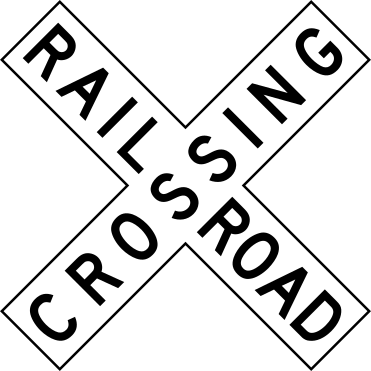
Correct answer: The same as a yield sign
Why: Treat a crossbuck the same as a yield sign. Slow down, look for trains and be ready to stop (Colorado Driver Handbook, p. 21).
-
Q20. May you park inside an intersection?
Correct answer: No, parking within an intersection is not allowed
Why: You may not park within an intersection (Colorado Driver Handbook, p. 13).
-
Q21. Your headlights suddenly go out while you are driving at night. What should you do?
Correct answer: Pull off the road as soon as possible and try the headlight switch a few times
Why: If your headlights fail, pull off the road as soon as possible and try the headlight switch a few times. If that does not work, put on your emergency flashers (Colorado Driver Handbook, p. 26).
-
Q22. Before you turn across a set of light rail tracks, what should you do?
Correct answer: Check in all directions
Why: Light rail vehicles may travel with traffic or against it, so never turn across the tracks without checking in all directions (Colorado Driver Handbook, p. 21).
-
Q23. You park headed uphill on a road with no curb. Which way should you turn your front wheels?
Correct answer: To the right
Why: With no curb, turn your front wheels to the right so that if the car rolls, it rolls off the road instead of into traffic (Colorado Driver Handbook, p. 14).
-
Q24. What does a green sign like this one give you?
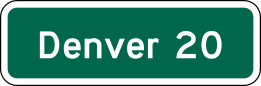
Correct answer: Directions and distances to places
Why: Guide signs have a green background and give directions and mileage to places (Colorado Driver Handbook, p. 8).
-
Q25. You can't give a bicyclist at least three feet of space to pass. What should you do?
Correct answer: Slow down and stay behind the bicyclist until it is safe to pass
Why: If you cannot give three feet of passing space, slow down and remain behind the bicyclist until it is safe to pass (Colorado Driver Handbook, p. 22).
-
Q26. A freeway on-ramp has a traffic signal (a metered ramp). What must you do?
Correct answer: Stop and wait for the green light before entering the freeway
Why: On metered ramps, you must stop and wait for the green light before you enter the freeway (Colorado Driver Handbook, p. 14).
-
Q27. What do arrows painted in a lane, like this one, tell you?
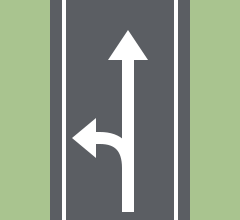
Correct answer: Which way you may go or turn from that lane
Why: Arrows painted on the road show which lanes to use for turns (Colorado Driver Handbook, p. 8).
-
Q28. Who has the right-of-way in a bike lane?
Correct answer: People on bikes
Why: People on bikes have the right-of-way in a bike lane (Colorado Driver Handbook, p. 22).
-
Q29. On a freeway, may you drive across the median to turn around?
Correct answer: No, never drive across, over or within a median or island
Why: On a freeway, do not drive across, over or within any median or island (Colorado Driver Handbook, p. 14).
-
Q30. What do yellow lines on the road, like this one, separate?

Correct answer: Traffic moving in opposite directions
Why: Yellow lines separate traffic going in opposite directions (Colorado Driver Handbook, p. 9).
-
Q31. A bicyclist ahead of you holds their right arm straight out to the side. What does this mean?
Correct answer: They plan to turn right
Why: For a right turn, a bicyclist may hold the right arm straight out, or hold the left arm up bent at a right angle (Colorado Driver Handbook, p. 23).
-
Q32. After you change lanes, when should your turn signal be turned off?
Correct answer: Within 3 seconds of finishing the lane change
Why: Turn off your signal within 3 seconds of completing the lane change so other drivers aren't misled (Colorado Driver Handbook, p. 15).
-
Q33. Besides keeping you in your lane, what else does a solid white line mark?
Correct answer: The shoulder of the road
Why: A solid white line means stay in your lane, and it also marks the shoulder of the road (Colorado Driver Handbook, p. 9).
-
Q34. In which direction must bicyclists ride on the road?
Correct answer: In the same direction as traffic
Why: Bicyclists are required to ride in the same direction as motor vehicles, but you should still look for them anywhere on the road (Colorado Driver Handbook, p. 23).
-
Q35. When should you begin to speed up as you drive through a curve?
Correct answer: After you reach the middle of the curve
Why: Slow down before the curve and begin to speed up only after you reach the middle of it (Colorado Driver Handbook, p. 16).
-
Q36. As a general rule, which part of the road must you drive on?
Correct answer: The right half of the road
Why: As a general rule, you must drive on the right half of the road (Colorado Driver Handbook, p. 9).
-
Q37. May you drive with only your parking lights on?
Correct answer: No, do not drive with only your parking lights on
Why: Do not drive with only your parking lights on. Use your headlights from sunset to sunrise or whenever you can't see 1,000 feet ahead (Colorado Driver Handbook, p. 16).
-
Q38. At night, an oncoming car's headlights are glaring at you. Where should you look?
Correct answer: Below the glare, using the painted edge lines to guide you
Why: Never look straight into oncoming headlights; drop your eyes below the glare and follow the painted edge lines until the car passes (Colorado Driver Handbook, p. 16).
-
Q39. How should you change your following distance at night or on roads you don't know?
Correct answer: Increase it
Why: Increase your following distance when driving at night or on unfamiliar roads (Colorado Driver Handbook, p. 16).
-
Q40. When are roads covered with snow or ice most dangerous?
Correct answer: When the snow or ice begins to melt
Why: Snowy and icy roads are most hazardous when the snow or ice starts to melt, because tires grip even less (Colorado Driver Handbook, p. 17).
-
Q41. Your car does not have anti-lock brakes, and you need to stop on a slippery road. How should you brake?
Correct answer: Press the brake firmly, just short of locking the wheels
Why: Without anti-lock brakes, use threshold braking: apply brake pressure up to a point just short of locking up the brakes (Colorado Driver Handbook, p. 17).
-
Q42. On a snowy or icy day, how should you treat pedestrians and bicyclists?
Correct answer: Give them extra space, since they may need to move around snow or ice
Why: Give pedestrians and bicyclists extra space in winter because they may need to steer around snow or ice on sidewalks or in the road (Colorado Driver Handbook, p. 17).
-
Q43. When driving through a work zone, where should you position your car?
Correct answer: Away from the workers
Why: In a work zone, move your lane position away from workers and slow down (Colorado Driver Handbook, p. 11).
-
Q44. Headlights should be used:
Correct answer: From sunset to sunrise, or when visibility is less than 1,000 feet
Why: Colorado law requires headlights from sunset to sunrise, or whenever visibility is less than 1,000 feet.
-
Q45. If traffic signals are not working at an intersection, you should:
Correct answer: Treat the intersection as a four-way stop
Why: Without signals, yield as at a four-way stop.
-
Q46. When your accelerator sticks, you should first:
Correct answer: Shift to neutral and steer to a safe area
Why: Shift to neutral, steer off the road, then stop.
-
Q47. Entering a roundabout, you must:
Correct answer: Yield to traffic already in the circle
Why: Traffic inside the roundabout has the right-of-way.
-
Q48. The best way to merge onto a freeway is to:
Correct answer: Match the speed of traffic and merge when safe
Why: Use the acceleration lane to reach traffic speed and merge smoothly when a safe gap appears.
-
Q49. A school bus is stopped ahead with its red lights flashing. What is the minimum distance from the bus at which you must stop?
Correct answer: 20 feet
Why: You must stop at least 20 feet before reaching a school bus that is stopped with its red lights flashing (Colorado Driver Handbook, DR 2337, January 2025, p. 11).
-
Q50. A single solid white line between lanes indicates:
Correct answer: You must stay within your lane
Why: A solid white line requires you to stay within the lane and also marks the shoulder of the roadway (Colorado Driver Handbook, DR 2337, January 2025, p. 9).