Colorado DMV Permit Practice Test 3: 50 Questions
Published · Updated
Practice Test 3 has 50 multiple-choice questions on Colorado driving rules, including business district speed limit, bicyclists on sidewalks, sharrow markings and no passing near intersections. Each answer is explained as soon as you pick it, and every question is listed with its answer in the study guide below.
More Colorado Practice Tests
Practice by Topic
What Practice Test 3 Covers
The questions in this test ask about:
- Business District Speed Limit
- Railroad Clearance Room
- Bicyclists on Sidewalks
- Ending a Hand Signal
- Railroad Track Count Sign
- Uphill Parking With a Curb
- Brown Recreation Signs
- No Passing Near Intersections
- Sharrow Markings
- HOV Diamond Lanes
- Bicycle Passing Distance
Try 5 Questions from This Test
-
Dim high beams for oncoming traffic within about:
Show answer
C. 500 feet
Dim within roughly 500 feet of oncoming vehicles to avoid glare.
-
When you drive through or turn at an intersection, in what order should you look?
Show answer
C. Left, right, then left again
Always look left, right and then left again when turning, driving through or entering an intersection (Colorado Driver Handbook, p. 18).
-
As a rule of thumb, how long should your turn signal be on before you turn or change lanes?
Show answer
C. At least 3 seconds
A good rule of thumb is to have your turn signal on for at least 3 seconds before you turn or change lanes (Colorado Driver Handbook, p. 12).
-
When you are backing up, which vehicles must you yield to?
Show answer
B. All vehicles close enough to be a hazard
When reversing, yield to all vehicles close enough to be a hazard (Colorado Driver Handbook, p. 11).
-
Can a Colorado driver be convicted of impaired driving with a BAC below 0.08%?
Show answer
C. Yes, based on how they were driving and other signs of impairment
Impaired driving is proven by the driver's behavior and all the facts together, not only by BAC (Colorado Driver Handbook, p. 3).
Complete Study Guide: All 50 Questions with Answers
Every question in Practice Test 3, with the correct answer and an explanation for each.
-
Q1. Unless a sign shows a different limit, what is the speed limit in a business district in Colorado?
Correct answer: 25 mph
Why: Unless another limit is posted, Colorado's speed limit in any business district is 25 mph (Colorado Driver Handbook, p. 12).
-
Q2. Before driving onto a railroad crossing, you should be sure the tracks are clear and that:
Correct answer: There is enough room on the other side of the tracks to clear a train
Why: Do not drive onto a crossing until the tracks are clear and you have enough room on the other side to clear a train (Colorado Driver Handbook, DR 2337, January 2025, p. 21).
-
Q3. What colors are warning signs?
Correct answer: Yellow or fluorescent green with black symbols
Why: Warning signs are yellow or fluorescent green with black symbols (Colorado Driver Handbook, DR 2337, January 2025, p. 8).
-
Q4. Seat belts in Colorado are required for:
Correct answer: The driver and front-seat passengers, with proper child restraints for kids
Why: Colorado requires the driver and front-seat passengers to wear seat belts. Children must ride in the right child restraint, and drivers under 18 must make sure all passengers buckle up.
-
Q5. A bicyclist is riding on the sidewalk. What rights and responsibilities do they have there?
Correct answer: The same as pedestrians
Why: Bicyclists riding on a sidewalk or crosswalk have the same rights and responsibilities as pedestrians (Colorado Driver Handbook, DR 2337, January 2025, p. 11).
-
Q6. When turning left across oncoming traffic on a snowy day, you should:
Correct answer: Wait for a large gap; turns take longer on slick roads
Why: Allow extra time and distance on low-traction surfaces.
-
Q7. On steep, icy downgrades, the safest technique is to:
Correct answer: Shift to a lower gear early and brake gently
Why: Use engine braking and light pedal pressure to stay in control.
-
Q8. When you drive through or turn at an intersection, in what order should you look?
Correct answer: Left, right, then left again
Why: Always look left, right and then left again when turning, driving through or entering an intersection (Colorado Driver Handbook, p. 18).
-
Q9. Can a Colorado driver be convicted of impaired driving with a BAC below 0.08%?
Correct answer: Yes, based on how they were driving and other signs of impairment
Why: Impaired driving is proven by the driver's behavior and all the facts together, not only by BAC (Colorado Driver Handbook, p. 3).
-
Q10. Your turn signals don't work, so you're using hand signals. When should you end your hand signal?
Correct answer: Before you start to turn, so both hands are on the wheel
Why: End your hand signal before you start to turn, so you can complete the turn with both hands on the wheel (Colorado Driver Handbook, p. 12).
-
Q11. What does this sign mean?
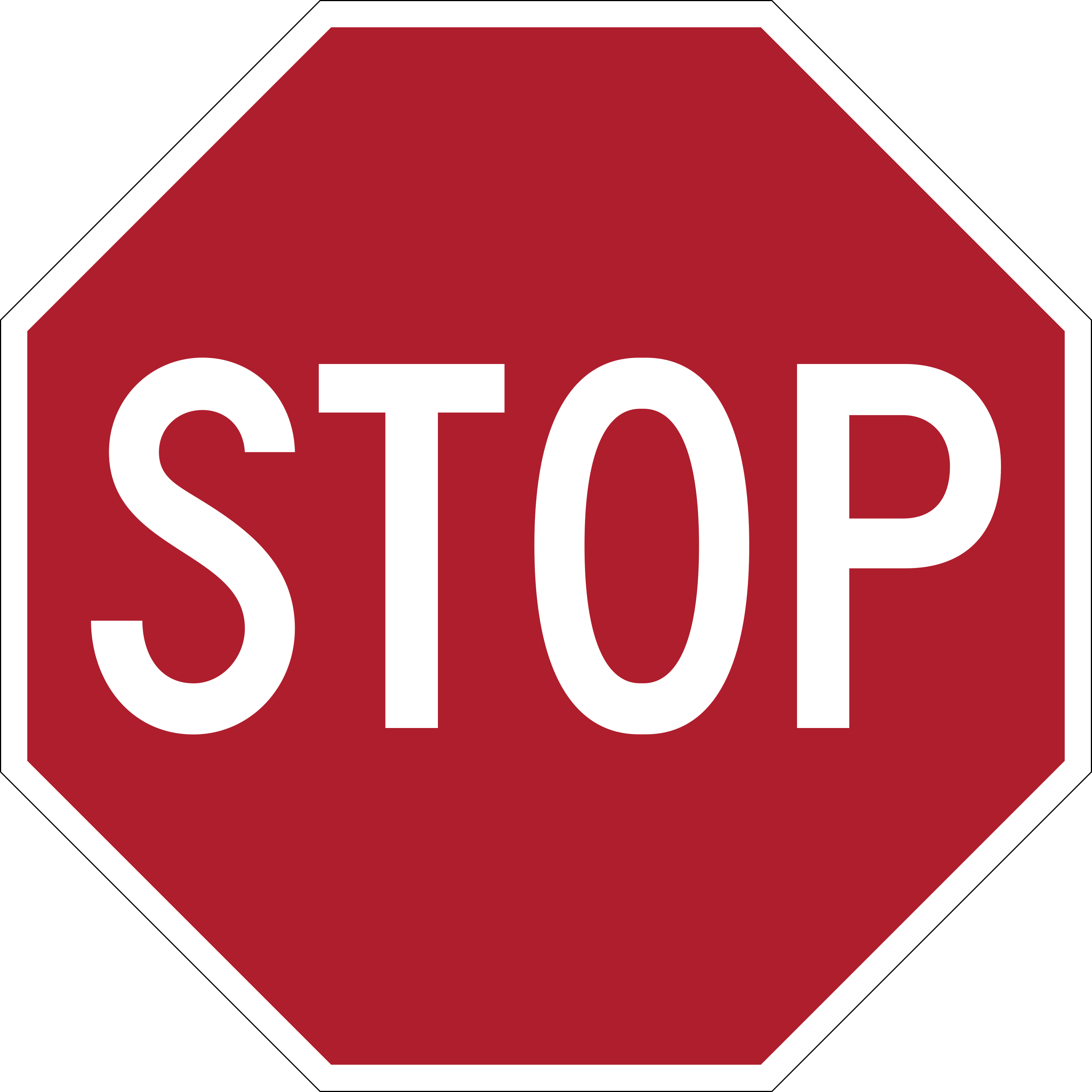
Correct answer: You must come to a complete stop
Why: A stop sign means you must come to a complete stop before going on (Colorado Driver Handbook, p. 7).
-
Q12. As a rule of thumb, how long should your turn signal be on before you turn or change lanes?
Correct answer: At least 3 seconds
Why: A good rule of thumb is to have your turn signal on for at least 3 seconds before you turn or change lanes (Colorado Driver Handbook, p. 12).
-
Q13. On a street with no special turn-lane signs or markings, where should you be when you start a right turn?
Correct answer: In the rightmost lane, as close to the right curb as possible
Why: For a right turn, start in the rightmost lane and turn from the right part of your lane, as close to the curb as possible (Colorado Driver Handbook, p. 12).
-
Q14. When you finish a turn onto a new road, which lane should you end up in?
Correct answer: The center of the correct lane, usually the one closest to you
Why: Finish your turn in the center of the correct lane on the new road, which is usually the lane closest to you on your side of the street (Colorado Driver Handbook, p. 12).
-
Q15. May you park on a crosswalk or a sidewalk?
Correct answer: No, parking there is not allowed
Why: Crosswalks and sidewalks are on the list of places where you may not park (Colorado Driver Handbook, p. 13).
-
Q16. You are waiting for a train to pass at a crossing with these pavement markings. Where must you stop?
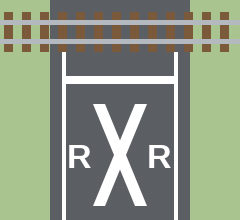
Correct answer: Behind the painted stop line
Why: Railroad pavement markings include an R X R and a stop line. Always stay behind the painted stop line while a train passes (Colorado Driver Handbook, p. 21).
-
Q17. What does this sign warn you about?

Correct answer: An area where pedestrians may be crossing
Why: This warning sign marks an area where many pedestrians may be on or crossing the road (Colorado Driver Handbook, p. 8).
-
Q18. When should you adjust your seat, mirrors, radio and temperature?
Correct answer: Before you start your trip
Why: Set your seat, mirrors, radio and temperature and secure loose objects before you start, so they don't distract you while driving (Colorado Driver Handbook, p. 6).
-
Q19. At a railroad crossing, a sign with a number is posted below the crossbuck. What does the number tell you?
Correct answer: How many tracks there are at the crossing
Why: When a crossing has more than one track, a sign below the crossbuck shows the number of tracks (Colorado Driver Handbook, p. 21).
-
Q20. You park headed uphill next to a curb. Which way should you turn your front wheels?
Correct answer: Away from the curb
Why: When parking uphill next to a curb, turn your front wheels away from the curb and let the car roll back until a front tire rests against the curb (Colorado Driver Handbook, p. 14).
-
Q21. You see a train coming and think you can get across the tracks first. What should you do?
Correct answer: Stop and wait; never try to beat a train
Why: Never try to beat a train across the tracks (Colorado Driver Handbook, p. 8).
-
Q22. Light rail crossings may use traffic lights, warning lights or gates. When these signals are active, what do they mean?
Correct answer: Stop and do not cross the tracks
Why: Whether a light rail crossing uses traffic lights, warning lights or gates, all of these signals mean the same thing: stop and do not cross (Colorado Driver Handbook, p. 22).
-
Q23. When should you stop in a freeway acceleration lane?
Correct answer: Only when it is absolutely necessary
Why: Use the acceleration lane to build up speed, and do not stop in it unless you absolutely must (Colorado Driver Handbook, p. 14).
-
Q24. A sign with a brown background, like this one, points you to:

Correct answer: Recreational, historic or cultural areas
Why: Brown signs point to recreational, historic or cultural areas (Colorado Driver Handbook, p. 8).
-
Q25. Two bicyclists are riding side by side and are not slowing normal traffic. Is this legal?
Correct answer: Yes, it is legal
Why: Bicyclists may ride side by side if they are not impeding the normal movement of traffic. It can make them easier to see (Colorado Driver Handbook, p. 22).
-
Q26. On a freeway, what is the leftmost lane mainly for?
Correct answer: Passing other vehicles
Why: The leftmost lane is the passing lane, kept for passing, left turns and times when traffic is too heavy to move over; slower drivers belong in the rightmost lane (Colorado Driver Handbook, p. 14).
-
Q27. When may a car with a disabled parking placard park in a disabled parking space?
Correct answer: Only when the person the placard belongs to is getting in or out of the car
Why: To park in a disabled space, the person who owns the placard must be getting in or out of the vehicle (Colorado Driver Handbook, p. 9).
-
Q28. Before you turn left, where should you look for oncoming bicyclists?
Correct answer: On the shoulder or along the edge of the lane
Why: Before a left turn, look for oncoming bicyclists riding on the shoulder or the edge of the lane, and take time to judge their speed and distance (Colorado Driver Handbook, p. 24).
-
Q29. Where are your vehicle's blind spots?
Correct answer: Slightly to the sides and rear of your vehicle, where your mirrors don't show
Why: Blind spots are areas you can't see in your rearview or side mirrors, slightly to the sides and rear of your vehicle, so look over your shoulder before changing lanes (Colorado Driver Handbook, p. 15).
-
Q30. What do white lines between lanes, like this one, separate?

Correct answer: Lanes of traffic moving in the same direction
Why: White lines separate lanes of traffic going the same direction (Colorado Driver Handbook, p. 9).
-
Q31. A bicyclist ahead holds their left arm bent down at the elbow. What does this mean?
Correct answer: They are slowing down or stopping
Why: A bicyclist who is slowing or stopping drops the left arm down at the elbow (Colorado Driver Handbook, p. 23).
-
Q32. You may not pass another vehicle within how many feet of an intersection or railroad crossing?
Correct answer: 100 feet
Why: Passing within 100 feet of an intersection or railroad crossing is illegal (Colorado Driver Handbook, p. 16).
-
Q33. What does a shared lane marking (sharrow), like this one, tell you?
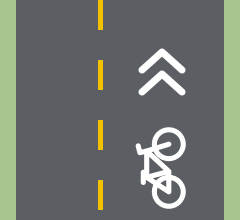
Correct answer: The lane may be too narrow for cars and bicyclists to go side by side
Why: A sharrow means the lane may be too narrow for a car and a bike to travel side by side, so bicyclists may use the center of the lane (Colorado Driver Handbook, p. 9).
-
Q34. How should you set your following distance when driving behind a motorcycle?
Correct answer: Increase it
Why: Motorcycles can stop quicker than expected, so use extra caution around them and increase your following distance (Colorado Driver Handbook, p. 23).
-
Q35. Should you assume a pedestrian can see or hear your vehicle?
Correct answer: No, some pedestrians may be deaf, hard of hearing or blind
Why: Do not assume pedestrians can see or hear your car or crossing signals, because some may be deaf, hard of hearing, deaf-blind or blind (Colorado Driver Handbook, p. 24).
-
Q36. On a road with marked lanes, how should you drive?
Correct answer: Use only one lane; don't straddle two lanes
Why: Stay in one lane at a time and do not straddle lanes (Colorado Driver Handbook, p. 9).
-
Q37. What does a white diamond painted in a lane, like this one, mean?
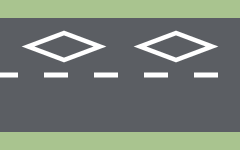
Correct answer: The lane is set aside for a special use, such as high occupancy vehicles
Why: A white diamond marks a restricted lane, such as an HOV, transit or bike lane; signs tell you who may use it (Colorado Driver Handbook, p. 10).
-
Q38. Who may use a High Occupancy Vehicle (HOV) lane?
Correct answer: Only the types of vehicles, carrying the number of people, that its signs allow
Why: Signs for an HOV lane list the types of vehicles and how many people each vehicle needs to use the lane (Colorado Driver Handbook, p. 10).
-
Q39. As you enter or leave a roundabout, who in the crosswalk must you yield to?
Correct answer: Pedestrians and bicyclists
Why: As you enter or leave a roundabout, yield to pedestrians or bicyclists in any crosswalk (Colorado Driver Handbook, p. 10).
-
Q40. Another driver doesn't give you the right-of-way when they should. Who is responsible for avoiding a crash?
Correct answer: You are, no matter who has the right-of-way
Why: Whoever has the right-of-way, you are always responsible for avoiding a crash (Colorado Driver Handbook, p. 11).
-
Q41. When you are backing up, which vehicles must you yield to?
Correct answer: All vehicles close enough to be a hazard
Why: When reversing, yield to all vehicles close enough to be a hazard (Colorado Driver Handbook, p. 11).
-
Q42. The red lights on a stopped school bus stop flashing. What should you do before driving on?
Correct answer: Watch carefully for children near the bus or crossing the road
Why: Before you go, carefully watch for children near the school bus and children crossing the road (Colorado Driver Handbook, p. 11).
-
Q43. Dim high beams for oncoming traffic within about:
Correct answer: 500 feet
Why: Dim within roughly 500 feet of oncoming vehicles to avoid glare.
-
Q44. Approaching a stationary maintenance or utility vehicle with flashing lights, you should:
Correct answer: Move over a lane or slow down if you cannot
Why: Change lanes away or slow down significantly and pass with caution.
-
Q45. At a four-way stop, the right-of-way goes to the driver who:
Correct answer: Arrives first or, if arriving together, is on the right
Why: First in, first out; otherwise yield to the vehicle on your right.
-
Q46. If you start to skid on ice, you should:
Correct answer: Ease off the accelerator and steer in the direction you want to go
Why: Look and steer where you want to go; avoid hard braking.
-
Q47. When passing a bicyclist on the road, you should:
Correct answer: Provide at least 3 feet of clearance
Why: Give bicyclists space and change lanes when possible.
-
Q48. Left turn on red in Colorado is permitted:
Correct answer: Only from a one-way street onto another one-way street, after stopping, unless a sign prohibits it
Why: Colorado allows a left turn on red only when turning from a one-way street onto another one-way street, after stopping and yielding, unless a sign prohibits it.
-
Q49. When backing out of a parking space you should:
Correct answer: Check behind you and both sides and back slowly
Why: Turn and look over your shoulder, check surroundings, and back out slowly.
-
Q50. On a divided highway, when a school bus stops with red lights flashing in the opposite lanes, you:
Correct answer: Do not have to stop but use caution
Why: On divided roadways, opposing traffic generally may proceed. Always watch for children.